Made to Measure Shirts: How a Dress Shirt Should Fit, and When Custom Is Worth It
A suit gets the attention, but the shirt does more work. It sits against your skin all day, it’s what people see when the jacket comes off, and for most professionals it’s the garment worn more often than any other. A small fit problem in a suit might go unnoticed. The same problem in a shirt, a collar that cuts in or a body that balloons above the belt, is visible from across the room.
Here is how a dress shirt should fit, what the main choices actually mean, and an honest view of when made to measure is worth it.
How a dress shirt should fit
Collar
You should be able to slide one finger, two at most, between the buttoned collar and your neck. Any tighter and it will dig in by mid morning; any looser and the collar will collapse under a tie. The collar points should sit flat under a jacket lapel rather than curling up or hiding beneath it.
Shoulders
The shoulder seam should finish at the edge of your shoulder bone. If it sits up on the shoulder, the shirt will pull when you reach forward. If it drops down the arm, the whole shirt looks a size too big even if the collar fits.
Chest and body
You want enough room to move comfortably, without excess fabric billowing out over the waistband when the shirt is tucked. Buttons shouldn’t pull open into gaps across the chest when you sit. A useful test: tuck the shirt in, lift your arms above your head, and see whether it stays put.
Sleeves
Sleeves should finish at the wrist bone, so that roughly a centimetre of cuff shows beyond your jacket sleeve. The cuff should be snug enough not to slide down over your hand, but loose enough to fit a watch.
Length
A dress shirt should be long enough to stay tucked through a full day, sitting and standing. A shirt designed to be worn untucked needs a shorter, straighter hem. A made to measure shirt can be cut to suit how you’ll actually wear it.
Where off the rack shirts go wrong
Off the rack shirts are sized mainly by collar and sleeve length, with the body cut to an assumed ratio. That works if your build matches the pattern. It doesn’t if:
• You have an athletic build. A collar that fits a strong neck usually arrives with a body cut for a much larger waist. Our guide to suits for athletic builds covers this from the jacket side.
• You’re tall and slim. Long enough sleeves usually means a tent through the body.
• Your arms are different lengths or one shoulder sits lower. This is common, and a custom pattern simply accounts for it.
• You have a broad chest or rounded posture, which can make the front of a shirt pull or the back billow.
If any of those sound familiar, a made to measure shirt fixes the problem at the pattern rather than relying on alterations.
Choosing a collar
Spread collar. The points angle outward, leaving space for a tie knot. The most versatile business collar and the safest first choice.
Cutaway collar. A wider spread that frames larger knots and also looks sharp without a tie. A good choice for weddings and modern business wear.
Button down collar. The points button to the shirt. More relaxed; ideal for smart casual and Oxford cloth shirts, less suited to formal suiting.
Mandarin or band collar. No points at all. Clean and contemporary, worn without a tie.
Wing collar. Reserved for black tie and formal evening wear.
Choosing a cuff
A barrel cuff fastens with one or two buttons and suits everyday wear. A French cuff (double cuff) folds back and fastens with cufflinks; it’s the formal choice for weddings, black tie and important occasions.
Choosing the cloth
Shirting cloth is described by its weave. The three you’ll meet most often:
|
Weave |
Feel |
Best for |
|
Poplin |
Smooth, light, crisp, with a slight sheen |
Warm weather, formal business, under a suit |
|
Twill |
Soft with a fine diagonal texture; drapes well and resists creasing |
Everyday business wear, easier ironing |
|
Oxford |
Heavier, textured basket weave |
Smart casual, button down collars, weekends |
For Queensland and northern NSW summers, a light poplin in cotton, or a linen shirt for casual wear, will be noticeably cooler than a heavy twill.
Are made to measure shirts worth it?
Honestly, it depends on how you wear shirts.
Probably worth it if you wear a shirt and jacket most working days, if off the rack shirts never fit your build, or if you want a shirt to coordinate exactly with a tailored suit.
Probably not necessary if you wear a dress shirt a few times a year and a standard size fits you reasonably well.
The value also compounds. Once your pattern is established, your measurements are kept on file, so ordering more shirts is far simpler than the first time. Many clients start with two or three in core colours, wear them for a few weeks, refine anything they’d change, and then build out from there.
What it costs at Suit Society
Our made to measure shirts are currently $219 in a blended cloth, $249 in 100% cotton, $269 in linen and $369 in branded mill fabrics. Customisation, including collar, cuff and monogram choices, is included. The full price list sets out every option. You can also browse a selection of our current shirts to see the style.
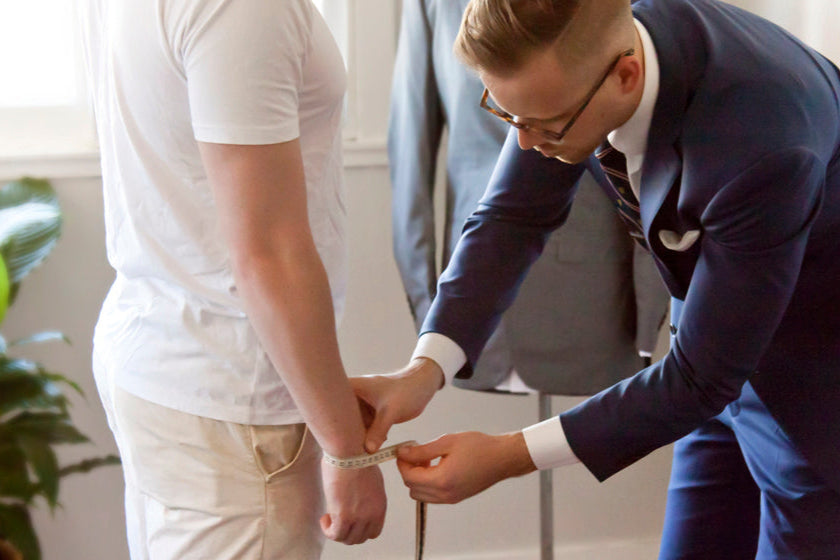
Shirts follow the same process as our suits: a consultation and measurements, a first fitting, then any final adjustments, all covered by our Perfect Fit Guarantee. From first appointment to collection typically takes three to eight weeks.
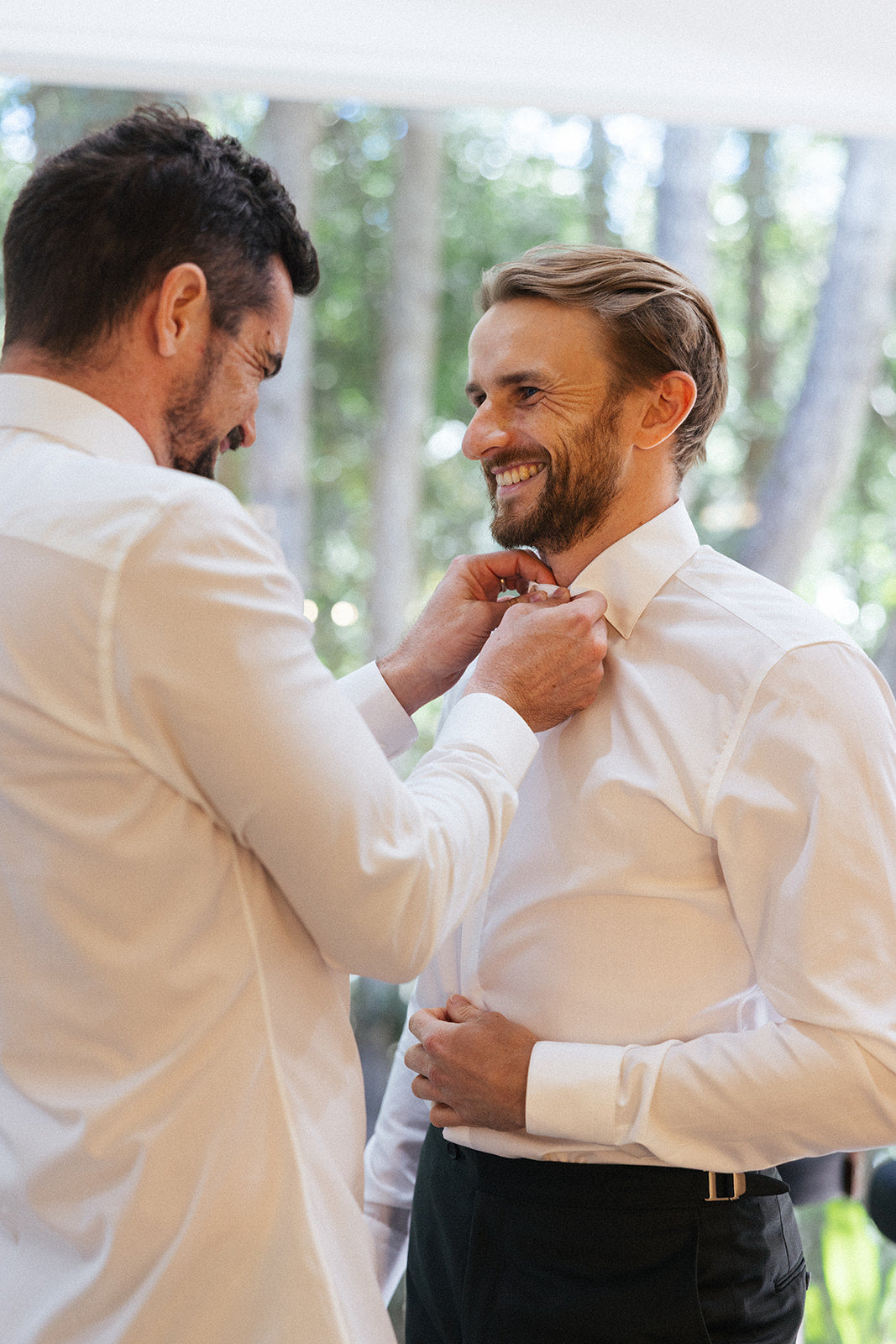
For grooms, a tailored shirt is included with your wedding suit. It’s one of the details in our wedding service.
Caring for a tailored shirt
Wash shirts cold, below 30°C, in the machine or by hand, and avoid dry cleaning, which is harsh on both the cotton and the buttons. Hang to dry on a shaped hanger and iron while slightly damp. Rotating between several shirts rather than wearing the same two on repeat will add years to all of them.
Building a shirt wardrobe
If you’re starting from scratch, three or four shirts cover most professional weeks: white and pale blue in a twill or poplin with a spread collar, then perhaps a fine stripe or a cutaway collar for variety. Our professional suit wardrobe guide shows how shirts fit into the bigger picture.
Get measured once, reorder with ease
The first shirt takes a consultation, measurements and a fitting. Every shirt after that starts from a pattern that already fits you.
Book a shirt consultation at your nearest studio, or by video with our Virtual Tailor.
Frequently asked questions
Are made to measure shirts worth it? They are most worth it if you wear shirts most working days or struggle to find off the rack shirts that fit your build. Once your measurements are on file, reordering is simple.
How much does a custom shirt cost at Suit Society? Made to measure shirts currently range from $219 to $369 depending on the fabric, with design options such as collar, cuff and monogram included.
How long does a made to measure shirt take? Typically three to eight weeks from your first appointment to final fitting, with expedited timing available if you have a deadline.
How should I wash a tailored shirt? Wash cold, below 30°C, by machine or hand, and avoid dry cleaning. Hang to dry and iron while slightly damp.